American beech (Fagus grandifolia) can become an undesirable species in managed forest systems when it forms dense understory thickets that suppress regeneration of desired tree species. At Fort Drum, this condition is common in previously harvested areas, where beech root sprouting has resulted in high-density regeneration that limits forest diversity and habitat quality.
In 2025, Adirondack Research partnered with Atlas Contracting Solutions LLC to implement targeted vegetation management across approximately 119 acres of forested land. The objective of this project was to reduce the density of American beech through selective herbicide application, thereby promoting the regeneration of desired species and improving overall forest structure and ecological function.
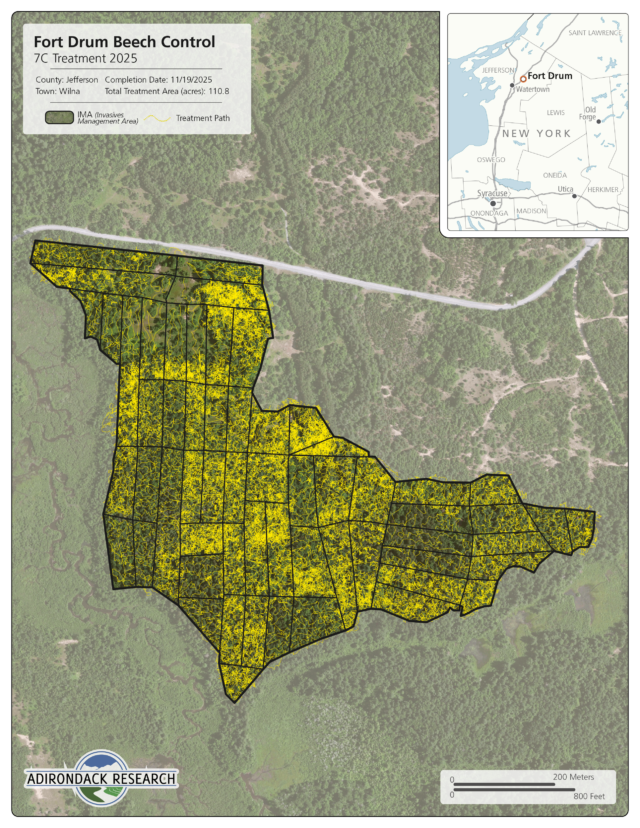
Design map to emphasize treatment coverage, stand-level density patterns, and applicator movement across large forest units, illustrating both the scale and precision of implementation.
Treatment areas included multiple management units characterized by dense, uniform beech sapling growth following prior harvest activity. Adirondack Research implemented a hack-and-squirt herbicide application methodology, a targeted approach that allows herbicide to translocate through the vascular system of individual stems while minimizing impacts to surrounding vegetation.
Field operations focused on the selective treatment of all American beech stems ≥1 inch DBH, using approved herbicides applied in accordance with label requirements and Fort Drum’s Integrated Pest Management protocols. This method is particularly effective in high-density sapling stands where mechanical removal would be impractical and more disruptive to soils and adjacent vegetation.
A central component of the project was the integration of GPS-enabled field workflows and GIS mapping. Crews navigated to predefined treatment units, recorded treatment paths in real time, and generated spatial datasets documenting treatment extent and coverage. These data were compiled into detailed maps that clearly illustrate treatment intensity and distribution across each management unit, supporting both reporting requirements and long-term planning.
All work was conducted in accordance with federal, state, and installation-specific environmental regulations, including pesticide certification requirements, protection of wetlands and sensitive habitats, and coordination with Fort Drum’s Natural Resources and Environmental Division.
The project successfully reduced the density of American beech across targeted areas, supporting long-term forest management goals including:
- Increased regeneration of desirable hardwood species
- Improved structural diversity within forest stands
- Enhanced habitat conditions for wildlife
- Reduced competition from undesirable understory vegetation
By combining precise field application with detailed spatial documentation, this project provides land managers with a scalable and repeatable framework for forest restoration, supported by clear, data-driven mapping outputs.
American beech (Fagus grandifolia) can become an undesirable species in managed forest systems when it forms dense understory thickets that suppress regeneration of desired tree species. At Fort Drum, this condition is common in previously harvested areas, where beech root sprouting has resulted in high-density regeneration that limits forest diversity and habitat quality.
In 2025, Adirondack Research partnered with Atlas Contracting Solutions LLC to implement targeted vegetation management across approximately 119 acres of forested land. The objective of this project was to reduce the density of American beech through selective herbicide application, thereby promoting the regeneration of desired species and improving overall forest structure and ecological function.
Design map to emphasize treatment coverage, stand-level density patterns, and applicator movement across large forest units, illustrating both the scale and precision of implementation.
Treatment areas included multiple management units characterized by dense, uniform beech sapling growth following prior harvest activity. Adirondack Research implemented a hack-and-squirt herbicide application methodology, a targeted approach that allows herbicide to translocate through the vascular system of individual stems while minimizing impacts to surrounding vegetation.
Field operations focused on the selective treatment of all American beech stems ≥1 inch DBH, using approved herbicides applied in accordance with label requirements and Fort Drum’s Integrated Pest Management protocols. This method is particularly effective in high-density sapling stands where mechanical removal would be impractical and more disruptive to soils and adjacent vegetation.
A central component of the project was the integration of GPS-enabled field workflows and GIS mapping. Crews navigated to predefined treatment units, recorded treatment paths in real time, and generated spatial datasets documenting treatment extent and coverage. These data were compiled into detailed maps that clearly illustrate treatment intensity and distribution across each management unit, supporting both reporting requirements and long-term planning.
All work was conducted in accordance with federal, state, and installation-specific environmental regulations, including pesticide certification requirements, protection of wetlands and sensitive habitats, and coordination with Fort Drum’s Natural Resources and Environmental Division.
The project successfully reduced the density of American beech across targeted areas, supporting long-term forest management goals including:
-
Increased regeneration of desirable hardwood species
-
Improved structural diversity within forest stands
-
Enhanced habitat conditions for wildlife
-
Reduced competition from undesirable understory vegetation
By combining precise field application with detailed spatial documentation, this project provides land managers with a scalable and repeatable framework for forest restoration, supported by clear, data-driven mapping outputs.